Solana RPC Benchmark & Failover Setup
A workload-specific Solana RPC assessment run from the client's deployment region, with reproducible results and production failover integration.
Priced for your scope. A short description is enough to start.
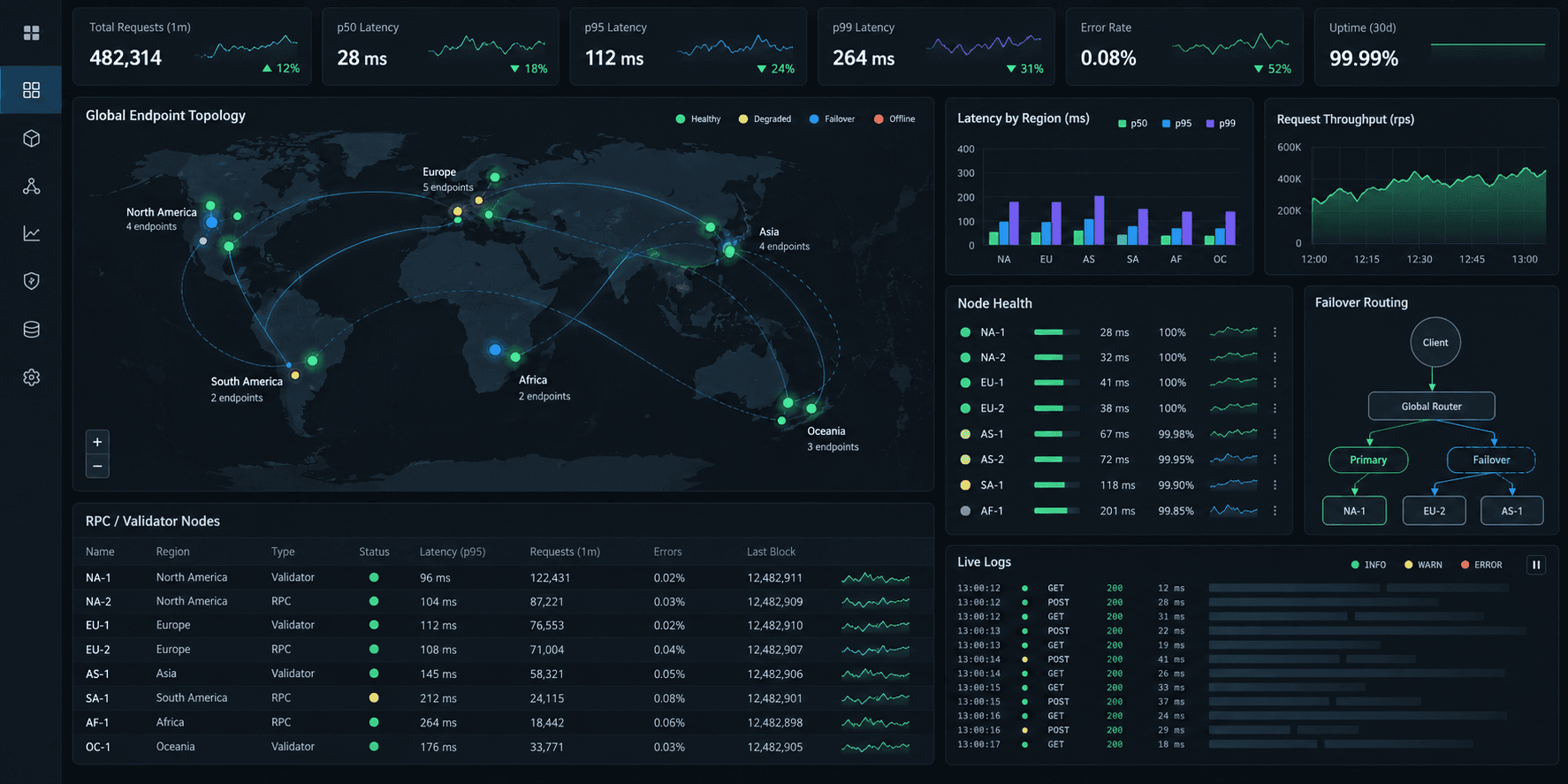
What's included
- Reproducible benchmark harness and raw results
- HTTP, WebSocket or Yellowstone test plan
- Latency, error-rate and freshness analysis
- Provider routing and fallback logic
- Monitoring dashboard and runbook
Best fit for
- Solana trading systems
- Wallets and analytics products
- Teams evaluating RPC providers
Solana RPC benchmarking for your application, not a generic leaderboard
An RPC endpoint can look fast in an average-latency chart and still be unsuitable for a trading application. A quote service, an account-state reader and a transaction submitter have different requirements. We start with the methods your software calls, its deployment region, commitment settings and expected request pattern, then agree a repeatable test plan.
This is a software engineering engagement for your selected providers and client-controlled deployment. TierZero does not sell hosted RPC subscriptions through this service. Provider and hosting charges are separate from development and are identified during scoping.
What the benchmark measures
| Measurement | Why it matters | Evidence in the agreed report |
|---|---|---|
| p50, p95 and p99 response time | Tail latency exposes delays hidden by averages. | Per-method samples, time window and percentile calculation. |
| HTTP/RPC errors and rate limits | A quick error response is not a successful read. | Error categories, sample counts and request rate. |
| Slot freshness | A responsive endpoint may return older state. | Commitment level, comparison source and observed slot differences. |
| Subscription recovery | A reconnected socket does not prove no events were missed. | Disconnects, reconnect timing and gap-detection behaviour. |
| Transaction submission and landing | Receiving a signature does not mean execution succeeded. | Separate acknowledgement and confirmed on-chain outcomes when transaction tests are included. |
We compare like-for-like methods, record warm-up and sampling rules, and keep provider plans and region visible in the methodology. Results apply to the measured workload and period; we do not label a provider universally fastest from a single run. A reproducible Solana RPC benchmark guide explains the basic approach.
Failover without blind retries
A failover layer needs more than a fallback URL. Read requests can be routed using method-specific health, timeouts, freshness thresholds and a circuit breaker. Recovery rules should prevent repeatedly switching providers during a short disturbance. Subscription failover also needs resubscription and state reconciliation appropriate to the application.
Transaction submission is handled separately. A timed-out request may already have reached the network. Before rebuilding or resending an action, the system needs to check its known signature and transaction validity rather than assume a timeout means nothing happened. The supported retry and reconciliation behaviour is written into the scope.
Acceptance scenarios for your implementation
- Make the primary endpoint time out and verify that eligible reads switch under the configured policy.
- Return stale state and confirm that freshness checks flag it even when the response is HTTP 200.
- Trigger a rate-limit response and verify backoff instead of a retry storm.
- Restore the primary endpoint and check recovery thresholds before returning traffic.
- Restart the application with pending submissions and verify that reconciliation runs before a new action is created.
These are test scenarios, not claims that a benchmark has already been performed on your infrastructure. Live transaction tests require a separately agreed test wallet, permissions and fee budget. Read-only benchmarking does not require a seed phrase or private key.
Deliverables and project inputs
The agreed delivery can include a runnable benchmark harness, raw samples, a methodology report, routing configuration, health metrics and an operator runbook. We document provider assumptions and explain how to rerun the tests after changing a plan, region or workload.
Send your deployment region, candidate providers, required methods, approximate request rate and whether you need read-only testing or transaction-path testing. Do not paste endpoint API keys into an enquiry. Request an RPC assessment and failover implementation; we agree the scope, acceptance criteria and fixed quote before work starts.
For the downstream application, see Solana copy trading development or our Solana development services. Your infrastructure, credentials and trading decisions remain under your control.
Technical scope
What we design and verify
A production solana rpc benchmark & failover setup is more than a working demo. Each major component below is scoped around the target network or platform, expected load, failure conditions and the way your team will operate it after handover.
Reproducible benchmark harness and raw results
Delivery includes repeatable setup instructions and a handover path for client-owned infrastructure, so operation does not depend on permanent access by TierZero.
HTTP, WebSocket or Yellowstone test plan
The data path is designed for reconnects, duplicate events and observable lag. We document provider assumptions and test recovery instead of treating a live connection as automatically reliable.
Latency, error-rate and freshness analysis
This part of Solana RPC Benchmark & Failover Setup is specified as a separate, testable component with acceptance criteria, logging and documented configuration rather than hidden hard-coded behavior.
Provider routing and fallback logic
Submission and execution logic includes simulation, configurable limits, explicit failure states and structured logs. Production credentials and signing authority remain separated from application logic.
Monitoring dashboard and runbook
Operational visibility is part of the delivered system: health, important actions, failures and relevant business metrics are exposed without placing private keys in the interface.
Definition of done
Before delivery, we validate the agreed happy path, expected failures and operational controls. You receive the applicable source code, configuration reference, deployment instructions and a walkthrough of the system. Any third-party fees, infrastructure subscriptions or external dependencies are identified during scoping.
Delivery
How the engagement works
Technical discovery
We confirm the objective, constraints, integrations and acceptance criteria.
Architecture & scope
You receive milestones, responsibilities, timeline and the final quote.
Build & verification
Implementation is tested against the agreed scenarios with visible progress.
Handover & support
We deploy or hand over the code, documentation and operating instructions.
Built for production
Scope, security and ownership
Delivery model
The engagement starts with evidence gathering and ends with prioritized, implementable recommendations.
Security baseline
Access is time-limited and findings are delivered privately with clear severity and remediation guidance.
What we need from you
The system boundary, current architecture, known risks and the decisions the review needs to support.
Questions before you start
How is Solana RPC Benchmark & Failover Setup priced?+
We quote each project after discussing the required features, integrations and deployment. Send a short description; a finished specification is not required. We agree the scope, milestones and price before work begins.
How long does delivery take?+
Timing depends on integrations, testing depth and whether existing code is involved. After a short technical discovery, we provide milestones and a delivery estimate before payment.
Who controls the source code, infrastructure and keys?+
The agreed source code and deployment are handed over to the client. Production wallets, seed phrases and private keys remain client-controlled; we design integrations around scoped credentials and least-privilege access.
How do we verify the result?+
We agree measurable acceptance criteria before implementation, then provide testing evidence, documentation and a handover walkthrough for the delivered scope.
Can you work with our existing code or infrastructure?+
Yes. We can begin with a focused review, identify reusable components and propose the smallest safe implementation path instead of forcing a full rebuild.
Technical resources
Related guides
Building RPC Failover Architecture for Solana Trading Bots
A production walkthrough of multi-provider active-passive failover for Solana trading bots — covering health checks, circuit breakers, and automatic re-routing with HAProxy and a custom health-check sidecar so a single RPC outage never halts your strategy.
Read guide InfrastructureBuilding a Multi-Provider RPC Failover Layer for Solana Bots
A single RPC endpoint is a single point of failure — we show how to build a weighted round-robin proxy in Rust that automatically routes around degraded providers, with health-check intervals tuned for HFT tolerances.
Read guide InfrastructureYellowstone gRPC Streaming on Solana: Complete Setup Guide
Step-by-step walkthrough for connecting to a Yellowstone-compatible geyser plugin via gRPC to stream accounts, transactions, and slots in real time. Covers authentication, filtering by program ID, and handling backpressure in production.
Read guideRelated services
Discuss your project and get an estimate
A few sentences about your idea are enough. We'll clarify the requirements and prepare an individual proposal. No finished specification or payment is needed to enquire.