Blockchain Data Pipeline
A client-owned data pipeline for reliable blockchain events, application-specific indexing, analytics and downstream APIs.
From $2,500 · final quote before payment
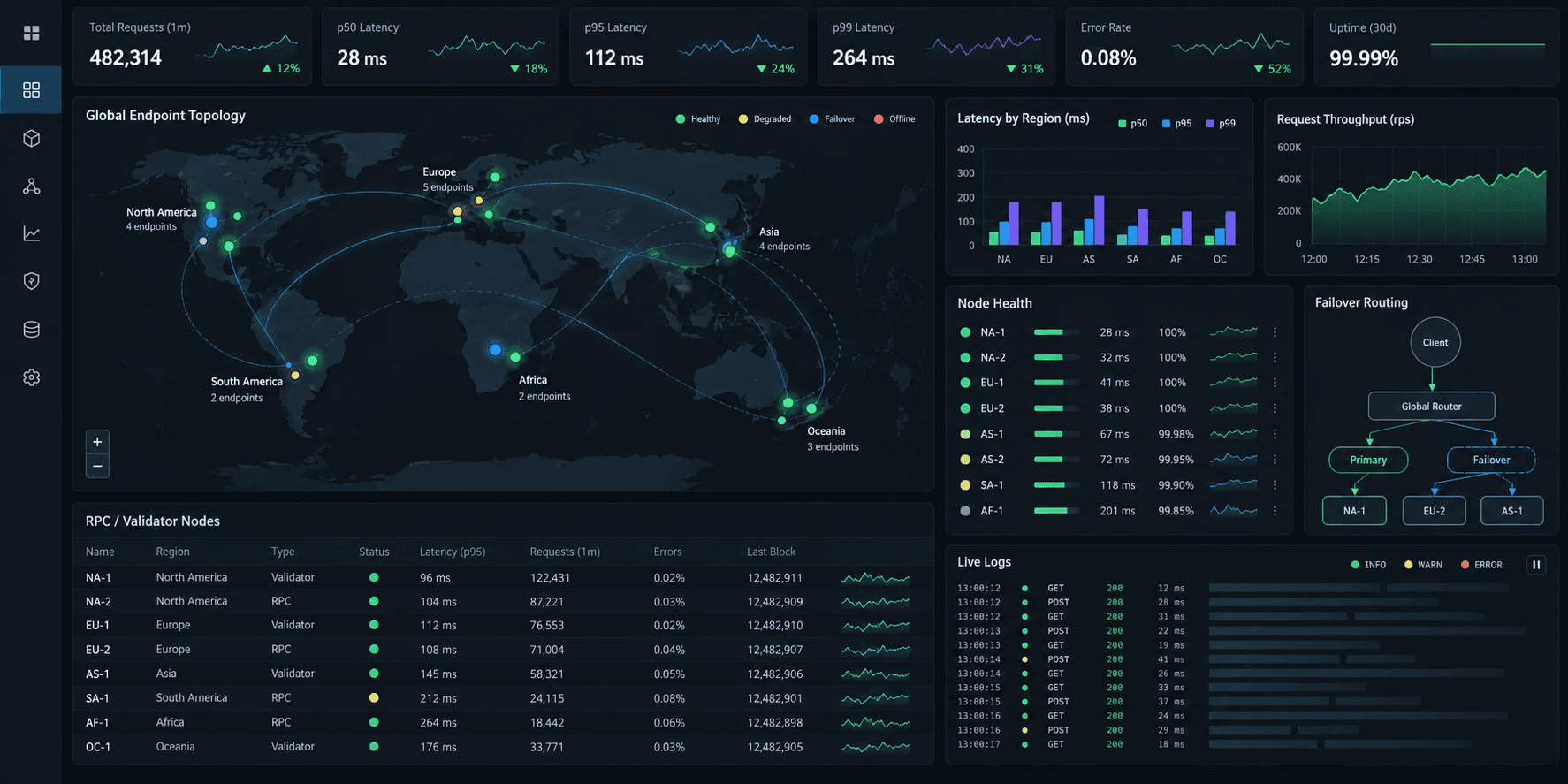
What's included
- RPC, WebSocket or gRPC ingestion
- Event decoding and normalized schema
- Checkpoints, deduplication and replay
- PostgreSQL or ClickHouse storage
- REST, WebSocket or internal APIs
Best fit for
- Analytics products
- Wallet and protocol dashboards
- High-volume blockchain applications
Data that can recover
We design pipelines around chain-specific realities such as reconnects, duplicate messages, forks or reorgs and incomplete upstream responses. Durable checkpoints and idempotent writes allow processing to restart without silently corrupting downstream state.
The client owns the deployment, database and provider accounts. Managed hosting can be evaluated separately when TierZero launches that product line.
Delivery and operational boundaries
TierZero provides software engineering, testing, documentation and deployment support. The client controls its infrastructure, accounts, credentials, wallets and product decisions. We do not custody client or end-user assets, transmit funds on a client's behalf, operate customer trading accounts, recommend specific investments or guarantee financial results. Production use remains subject to the client's legal, compliance and risk review.
Technical scope
What we design and verify
A production blockchain data pipeline is more than a working demo. Each major component below is scoped around the target network or platform, expected load, failure conditions and the way your team will operate it after handover.
RPC, WebSocket or gRPC ingestion
The data path is designed for reconnects, duplicate events and observable lag. We document provider assumptions and test recovery instead of treating a live connection as automatically reliable.
Event decoding and normalized schema
This part of Blockchain Data Pipeline is specified as a separate, testable component with acceptance criteria, logging and documented configuration rather than hidden hard-coded behavior.
Checkpoints, deduplication and replay
This part of Blockchain Data Pipeline is specified as a separate, testable component with acceptance criteria, logging and documented configuration rather than hidden hard-coded behavior.
PostgreSQL or ClickHouse storage
This part of Blockchain Data Pipeline is specified as a separate, testable component with acceptance criteria, logging and documented configuration rather than hidden hard-coded behavior.
REST, WebSocket or internal APIs
The data path is designed for reconnects, duplicate events and observable lag. We document provider assumptions and test recovery instead of treating a live connection as automatically reliable.
Definition of done
Before delivery, we validate the agreed happy path, expected failures and operational controls. You receive the applicable source code, configuration reference, deployment instructions and a walkthrough of the system. Any third-party fees, infrastructure subscriptions or external dependencies are identified during scoping.
Delivery
How the engagement works
Technical discovery
We confirm the objective, constraints, integrations and acceptance criteria.
Architecture & scope
You receive milestones, responsibilities, timeline and the final quote.
Build & verification
Implementation is tested against the agreed scenarios with visible progress.
Handover & support
We deploy or hand over the code, documentation and operating instructions.
Built for production
Scope, security and ownership
Delivery model
Application, data and infrastructure components are scoped as independently testable services with clear interfaces.
Security baseline
Secrets, authentication, observability, backups and deployment access are handled with least-privilege defaults.
What we need from you
User flows, integrations, traffic expectations, hosting constraints and existing code or infrastructure.
Questions before you start
What is included in the Blockchain Data Pipeline starting price?+
The $2,500 figure is a starting point. We confirm the exact scope, integrations, acceptance criteria and fixed quote before work begins. The listed deliverables are included unless the agreed proposal says otherwise.
How long does delivery take?+
Timing depends on integrations, testing depth and whether existing code is involved. After a short technical discovery, we provide milestones and a delivery estimate before payment.
Who controls the source code, infrastructure and keys?+
The agreed source code and deployment are handed over to the client. Production wallets, seed phrases and private keys remain client-controlled; we design integrations around scoped credentials and least-privilege access.
How do we verify the result?+
We agree measurable acceptance criteria before implementation, then provide testing evidence, documentation and a handover walkthrough for the delivered scope.
Can you work with our existing code or infrastructure?+
Yes. We can begin with a focused review, identify reusable components and propose the smallest safe implementation path instead of forcing a full rebuild.
Technical resources
Related guides
Building a Real-Time Solana Data Pipeline with Kafka and ClickHouse
End-to-end guide for streaming raw Solana transaction data from a geyser plugin into Kafka, transforming it, and landing it in ClickHouse for low-latency analytical queries used by trading signal engines. Covers schema design and handling slot gaps.
Read guide InfrastructureIndexing Solana Program Data: Yellowstone vs Substreams vs DIY
A production-focused comparison of Yellowstone geyser plugins, Messari Substreams, and a custom PostgreSQL pipeline for building queryable indexes of on-chain program state — covering throughput ceilings, reorg handling, operational overhead, and when each approach actually earns its complexity.
Read guide InfrastructureHiring a Solana Infrastructure Engineer: What to Actually Look For
Most candidates can configure an RPC node but few understand shred propagation, geyser plugin internals, or NUMA-aware thread pinning — we outline the interview signals, take-home task design, and market-rate ranges for trading-focused infra engineers in 2025.
Read guideRelated services
Get a practical scope, not a sales pitch
Tell us the target network or platform, required integrations, expected load and what you already have. We'll reply with the next technical questions, delivery plan and quote.